Getting started · Gong
Connect Gong to ArcGlass
Connect a Gong account with its API credentials and turn recorded sales calls into transcribed, analyzed conversations. About five minutes, start to finish.
Before you begin
What you'll need
ArcGlass access
An ArcGlass account with permission to create pipelines.
Gong access
A Gong account with Technical Administrator access — required to create API keys.
API key
An Access Key and Access Key Secret created in Gong's API settings.
Base URL
Your Gong API base URL, shown alongside the key (region-specific).
At a glance
The three-step flow
01
Select Gong
On the Ingestion step, choose Gong from Calls Sources.
02
Enter credentials
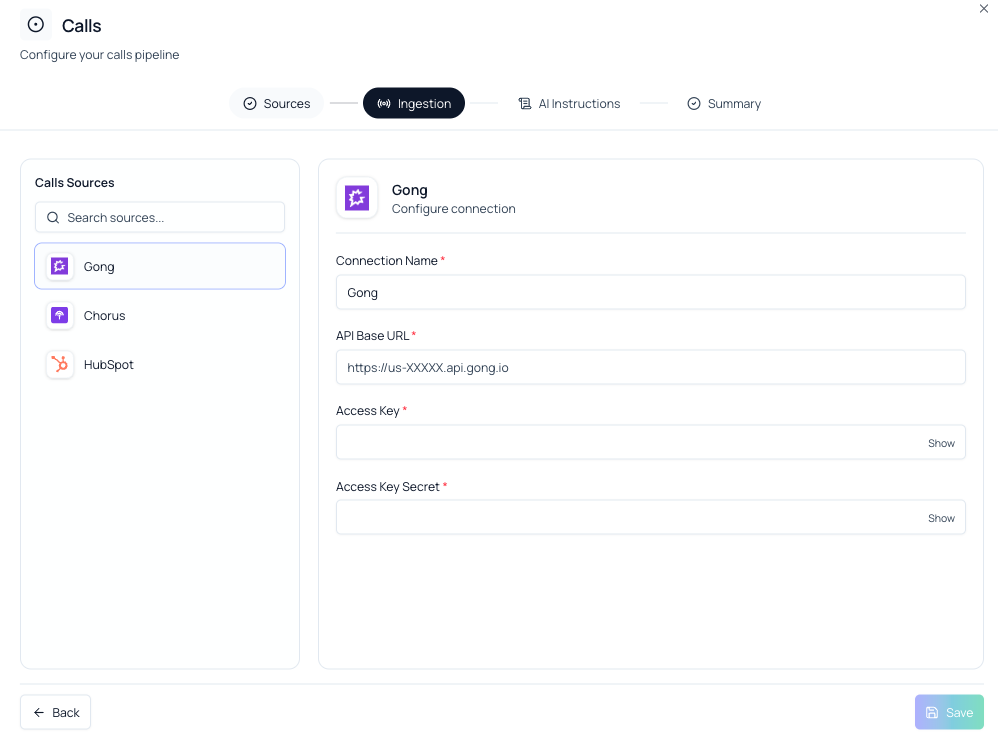
Paste your API Base URL, Access Key, and Access Key Secret.
03
Finish the pipeline
Save, continue through AI Instructions and Summary, then create.
Step by step
The full walkthrough
01
Select Gong as your call source
- Create a Calls pipeline. In ArcGlass, create a pipeline and choose Calls — the “Configure your calls pipeline” wizard opens.
- Open the Ingestion step. Under Calls Sources, select Gong.
- Keep the Connection Name. Leave it as Gong unless you manage more than one Gong instance.
02
Create a Gong API key
- Open Company Settings. In Gong, go to Company Settings.
- Select Ecosystem › API. This section requires Technical Administrator access.
- Create an API key. Gong shows an Access Key, an Access Key Secret, and your API Base URL.
Tip — Copy the Access Key Secret immediately — Gong displays it only once. The Base URL is region-specific, for example
https://us-XXXXX.api.gong.io.03
Enter the credentials and create the pipeline
- Fill the connection fields. Paste the API Base URL, Access Key, and Access Key Secret, then select Save.
- Continue through AI Instructions. Keep the defaults unless ArcGlass provides different settings.
- Review the Summary. Confirm the details and create the pipeline. Recorded calls begin syncing automatically.
Confirm it worked
Confirm onboarding is complete
Open Pipeline Runs
The newly created Calls pipeline should appear in the list.
Verify status
The pipeline should show Active. ArcGlass pulls recorded calls, transcribes them, and analyzes them as they become available.
Check the Calls page
Analyzed calls appear on the dedicated Calls page — pickup and voicemail funnel, dispositions, and messaging insights.
You're done when
The Calls pipeline is Active with Gong connected, and your recorded calls are syncing into the Calls page.
If something's off
Quick troubleshooting
Can't create an API key
Creating API keys requires Technical Administrator access in Gong — ask your Gong admin to generate one or grant access.
Connection is rejected
Re-copy the Access Key and Secret with no extra spaces, and confirm the API Base URL matches the one Gong showed with the key.
Wrong Base URL
Use the API Base URL from Gong's API key page — it is region-specific (for example https://us-XXXXX.api.gong.io), not always api.gong.io.
No calls appear
Only recorded calls are pulled. Confirm the calls have finished processing in Gong.
Older calls are missing
A standard run pulls recent calls first. Contact support@arcglass.io to backfill your full call history.